
By Wieteke Idzerda, Occupational Therapist, CRT Therapist
This year marks ten years since my Cognitive Remediation Therapy (CRT) journey began in Aotearoa New Zealand in 2015. It started with a single question posed by Dr Katrina Wallis (Occupational Therapist) at one of our bimonthly Occupational Therapy meetings at the then Waitematā District Health Board:
“Has anyone heard of Cognitive Remediation Therapy?”
None of us had. After a brief description of CRT—and its potential to support tāngata whai i te ora (clients, or more specifically, “people who seek wellness”), particularly those with schizophrenia who often have limited treatment options beyond medication—it didn’t take long for a small working group of Occupational Therapists to form that very day. The purpose of this group was to find out everything about CRT from existing programmes, literature, and technology.
Following several collaborative meetings with our clinical psychology colleagues, we developed our first CRT pilot programme. In 2016, eight clients completed a 16-week pilot incorporating key elements from multiple international CRT models. This included pen and paper tasks, a digital programme with cognitive exercises and a bridging social cognition group. The post-pilot review demonstrated excellent functional outcomes for our tāngata whai i te ora. This success enabled us to secure funding to travel to the Institute of Psychiatry, Psychology and Neuroscience at King’s College London, where we aimed to deepen our knowledge of CRT and bring this expertise home to Aotearoa New Zealand.
During training with Dr Matteo Cella and Dr Clare Reeder, we were introduced to CIRCuiTS™—the Computerised Interactive Remediation of Cognition and Thinking Skills programme. This innovative and evidenced-based digital therapy supports people experiencing serious mental illness and cognitive difficulties to enhance their functioning and overall quality of life. It does this by identifying very clear cognition related goals and focusing on metacognition.
By 2017, using what we had learnt from both our pilot and our time at King’s College London, we developed foundational CRT training within Waitematā Health and established the New Zealand CRT Steering Group. These training programmes ensured clinicians had the knowledge and skills required to implement CRT effectively. The Steering Group—comprising clinicians, researchers, lived-experience experts and policymakers—became a vital structure for national oversight, decision-making, and quality assurance for CRT across Aotearoa New Zealand.
In 2018, our collaboration and knowledge continued to grow nationally. We officially named CRT in New Zealand Te Rau Whakaaro – Thinking Skills for Life, reflecting our commitment to delivering cognitive rehabilitation tailored to our diverse population. That same year, we held our first National CRT Training in Waikato, facilitated by Dr Matteo Cella alongside New Zealand’s founding CRT members—an important milestone that united practitioners from across the motu.
In 2019, growth continued regionally, particularly within Auckland. Dr Melodie Barr, Clinical Psychologist at Counties Manukau, developed a foundational cognition training for all clinicians, which was soon adopted by Waitematā. This became a key part of our stepped-care model for cognition—an important development that increased accessibility by improving awareness and understanding across services.
In 2020, professional recognition and international collaboration strengthened further. We presented at the Australasian Forensic Occupational Therapy Forum, highlighting CRT’s role within forensic services. We also attended the Cognition Conference for Mental Health in Sydney, connecting with international experts and expanding our global network.
Despite the challenges of COVID-19, CRT in Aotearoa continued to grow, innovate, and deepen its evidence base through recent and emerging studies. Recommendations included that cognitive assessment should be routinely conducted within Mental Health Services (MHS) to identify cognitive strengths and deficits early (Morton et al. 2025). It has also been recommended that specific guidance is developed for leaders, clinicians, and policy makers on how to support the delivery of occupation-based CRT programmes in Aotearoa New Zealand (Wallis, 2024). Interest has increased nationwide, with New Zealand-based studies being completed.
We have learnt to adapt to the needs of tāngata whai i te ora and services—some clinicians deliver CRT individually, others in group formats. We now readily offer CIRCuiTS™ remotely with the therapist in the office and tāngata whai i te ora completing sessions from home. This approach is routinely offered in our rural districts, increasing accessibility to CIRCuiTS™ and has proven very successful.
We have continued to deliver CRT training annually—most recently in October 2025, facilitated by myself and Abbigail Barnard (OT), with participants from new districts, NGOs, and rehabilitation centres. The word is spreading, especially as more people witness CRT’s effectiveness and the positive outcomes it brings for our tāngata whai i te ora and their whānau.
Lessons learnt from the last 10 years
● Just do it! CRT can feel like a big undertaking, but once you start, it quickly becomes a smooth and rewarding process.
● Collaborate, be innovative, and utilise the resources around you to get CRT up and running.
● Keep offering training and support to clinicians to maintain momentum once they start.
● If you’re a small service running CRT, have a succession plan to ensure sustainability when staff move on.
● Share resources generously. The more we learn from each other, the greater the impact on our tāngata whai i te ora.
● Celebrate the wins —with your tāngata whai i te ora, colleagues, and wider teams.
● Keep reflecting and checking in – individually and as a group. Utilise supervision and steering groups to ensure the principles of CRT are being upheld.
Looking Ahead
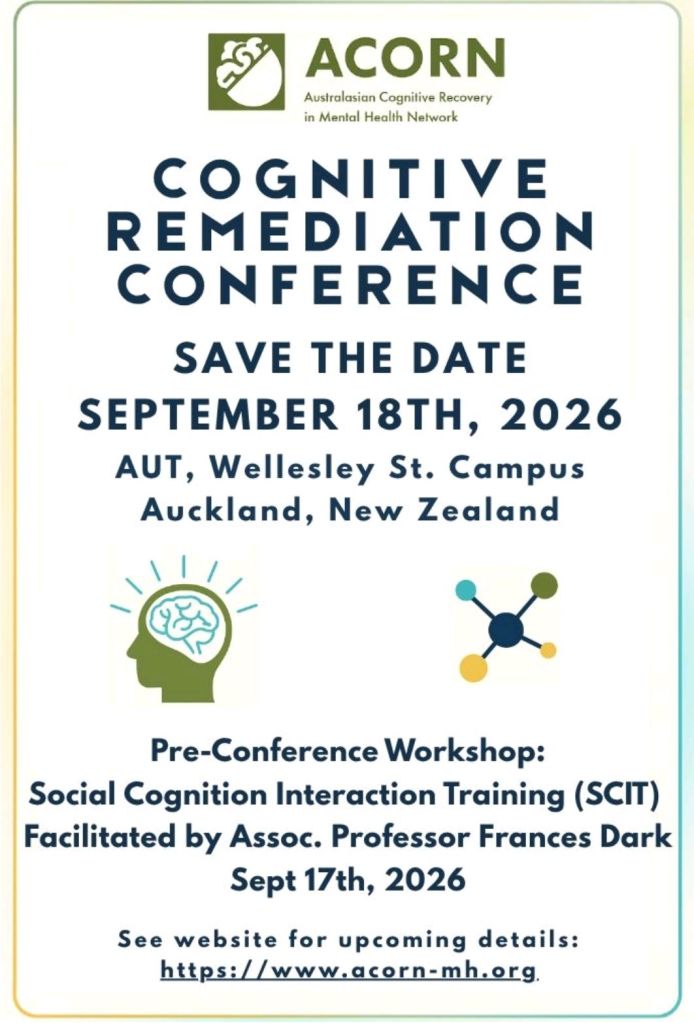
In 2026, Aotearoa New Zealand will host the ACORN Cognitive Remediation Conference, an international gathering of leaders in cognitive rehabilitation as well as an opportunity to show and teach what CRT is all about to those new to this intervention. This event will celebrate progress over the past decade and help shape the next chapter of CRT both nationally and internationally.
What’s Next for CRT in Aotearoa New Zealand Beyond 2026?
● National and regional expansion: Ongoing integration of CRT across healthcare, with increased collaboration both nationally and internationally.
● Technological innovation: Emerging digital tools and platforms will continue to enhance access to cognitive remediation.
● Policy influence: Continued advocacy and research may help embed CRT within mainstream mental health and cognitive-impairment pathways.
● Community outreach and prevention: Greater reach beyond clinical settings, including early-intervention and prevention programmes—particularly for younger populations at risk of cognitive challenges.
Summary
What began with just three districts has grown into a truly national movement. Today, CRT is delivered by professionals across Waitematā, Te Toka Tumai Auckland, Counties Manukau, Waikato, and Southern, with Captial, Coast and Hutt Valley soon to start offering it, and even more districts and specialist groups expressing interest in doing so. CRT is now offered across Adult Mental Health Services, Forensic Services, Work Rehabilitation, and Māori Specialist Services. While various models have been trialled, CIRCuiTS™ remains our main CRT programme for tāngata whai i te ora.
Further development is also underway in Child and Adolescent Mental Health and Early Psychosis Intervention (EPI) services. The growth and enthusiasm across the motu reflect CRT’s increasing recognition as an effective, meaningful, and hopeful approach that supports tāngata whai i te ora to achieve their goals, improve their functioning in daily life, and enhance their overall quality of life.
 Mind to Function
Leave a comment