Written by Wieteke Idzerda, Occupational Therapist, CRT Therapist
For as long as I can remember, I have often found myself reflecting on the invisible threads that shape who we are—not just as people, but as occupational beings. As an occupational therapist, I understand that what we do, how we do it, and why it matters is deeply influenced by context. But context isn’t just environment—it’s ancestry, migration, culture, and time.
For me, that story begins long before I was born, rooted in Dutch ancestry, and carried across to Aotearoa New Zealand. It unfolds through a childhood in the 80s and 90s—a time and place that quietly, but powerfully, shaped my sense of doing, being, becoming, and belonging.
Inherited Occupations: The Legacy of Doing
Dutch cultural values—diligence, productivity, and practicality—were not explicitly taught, but deeply embedded in everyday life. These values became internalised through repeated patterns of doing.
Through the lens of the Model of Human Occupation (MOHO), this reflects the development of habituation and volition. Habituation shaped the routines and expectations around productivity, while volition influenced what was valued—hard work, contribution, and usefulness (Kielhofner, 2008).
There was an unspoken message: doing matters.
As a result, productivity became closely tied to identity. Rest was something to be earned. Busyness became normalised. These early occupational patterns contributed to my emerging occupational identity – and still do.
Growing Up Kiwi: Freedom, Play, and Occupational Exploration
In contrast, growing up in New Zealand in the 80s and 90s offered a different occupational landscape—one grounded in outdoor play, independence, and exploration. My childhood became filled with camping, hunting, imaginary play with friends (no parents hovering near by). Play was my occupation.
This environment fostered volition in a different way. It supported intrinsic motivation, curiosity, and engagement in occupations for enjoyment rather than productivity. Within MOHO, this reflects the interplay between personal causation, values, and interests—core components of volition (Kielhofner, 2008).
Here, occupation was not just about doing—it was about being.
This dual exposure created an early awareness of occupational balance, even if I did not yet have the language to describe it.
Migration, Identity, and Belonging
Migration is not only a physical relocation—it is an occupational and identity transition. Even as a child, there is often a subtle (sometimes not so subtle) awareness of difference, of navigating between worlds. This was seen in the difference of language, traditions and behaviours.
Wilcock’s framework of doing, being, becoming, and belonging provides a helpful lens here (Wilcock, 2006). While I was firmly situated in New Zealand culture, my family’s European roots shaped a quieter layer of identity.
Belonging became something negotiated rather than assumed.
From an occupational perspective, this influenced how I engaged in roles and routines. It shaped my sense of self within occupations—how I performed, what I valued, and how I connected with others.
Making friends while being very direct and strong in my values of what is right or wrong did not always help me. School was not an easy learning environment for me when English was my second language. Unfortunately bilingualism in the 90s was discouraged so instead of learning to speak dutch fluently, we became a English speaking household. This isolated me from my Dutch heritage.
Occupational Identity: Integrating Two Worlds
Over time, these influences began to integrate rather than compete. I completely reached a point of acceptable when we were living in Europe during our OE (Overseas Experience) and I was able to spend much more time in Holland. I was able to consolidate my “uniqueness” – understand why I am who I am.
The structured, productivity-oriented habits of my ancestry combined with the flexibility and openness of Kiwi culture. Within MOHO, this reflects the development of occupational identity—a composite sense of who one is and wishes to become as an occupational being (Kielhofner, 2008).
My occupational identity became one that values both contribution and connection, both productivity and presence.
This integration highlights a key idea in occupational science: identity is not static. It evolves through experience, context, and reflection.
Te Ao Māori and Cultural Responsiveness: Expanding My Occupational Lens
Growing up in Aotearoa New Zealand also means growing alongside te ao Māori—the worldview of tāngata whenua. While this was not my cultural origin, it has become an essential part of how I understand health, wellbeing, and occupation.
As I’ve developed both personally and professionally, I’ve come to recognise that my own occupational lens—shaped by European ancestry and Western models of practice—is not universal. It is one way of seeing the world, not the way.
Frameworks such as Te Whare Tapa Whā (Durie, 1998) have challenged and enriched my understanding of wellbeing as inherently relational and holistic. The interconnected dimensions of taha tinana (physical), taha hinengaro (mental/emotional), taha wairua (spiritual), and taha whānau (family) expand the way occupation can be understood—not just as individual doing, but as something deeply embedded in identity, spirituality, and collective belonging.
This has required an ongoing process of reflection:
Recognising where Western models like the Model of Human Occupation may prioritise individual agency over collective identity.
Becoming more aware of how colonisation has shaped access to meaningful occupation for Māori.
Understanding that “balance” may look different across cultural contexts.
Letting go of assumptions about independence, productivity, and success.
Cultural responsiveness is not a destination—it is a continual practice of humility, listening, and unlearning.
For me, this means being open to different ways of knowing and doing. It means valuing whakawhanaungatanga (relationship-building) as central to occupational engagement. It means recognising that occupation can carry spiritual and ancestral significance, not just functional purpose.
Importantly, it also means sitting with discomfort at times—acknowledging what I don’t know, and being willing to learn.
Practice Implications: An Occupational Therapy Lens
These lived experiences now shape how I practice.
They have deepened my understanding of how culture, migration, and inherited values influence occupational participation. They remind me that what may appear as imbalance or dysfunction may instead reflect deeply embedded beliefs about doing and being.
Using MOHO, I am often drawn to exploring:
Volition: What motivates this person? What do they value?
Habituation: What routines and roles have been shaped over time?
Performance capacity: How does the person experience their ability to engage?
Environment: What cultural and social contexts are influencing occupation?
This perspective encourages a more nuanced and compassionate approach—one that honours the complexity of each person’s occupational story.
Coming Home to Occupational Balance
Reflecting now, I can see that my journey has been one of recalibration.
Learning that rest is not something to be earned, but something inherently valuable.
That productivity does not define worth.
That being and belonging are just as important as doing.
Occupational balance is not a fixed endpoint—it is dynamic, shaped by life stages, environments, and evolving identities (Townsend & Polatajko, 2013).
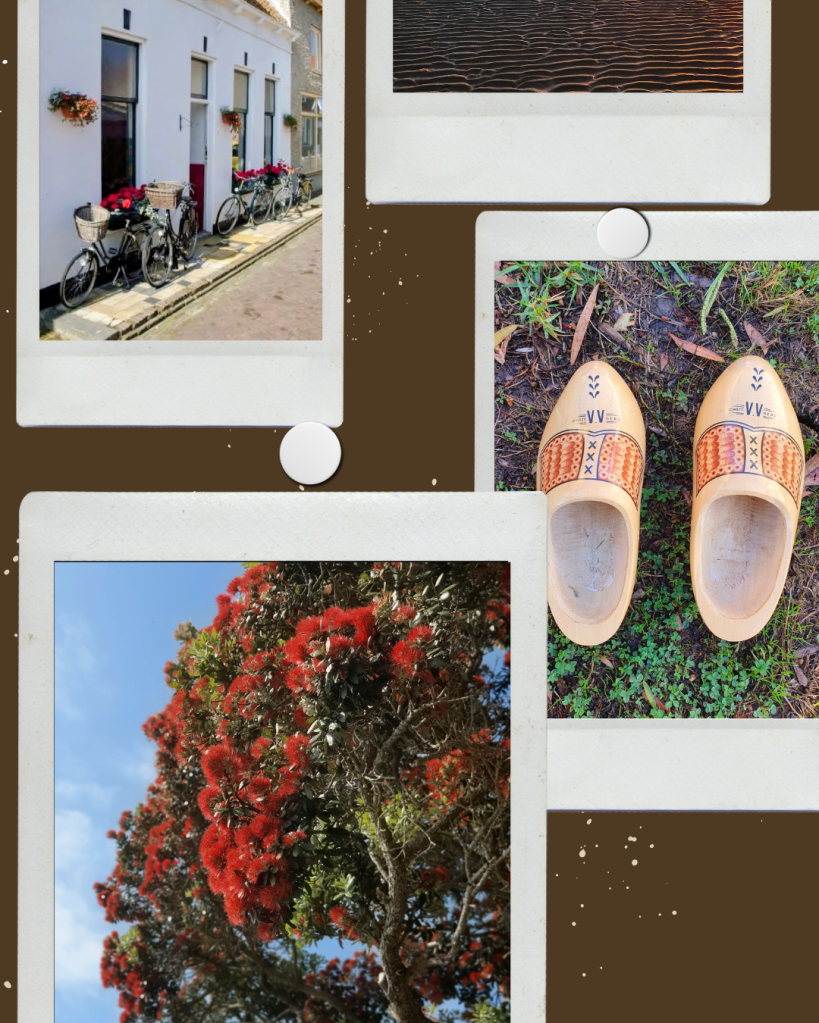
In the end, my occupational being is a story of both windmills and pōhutukawa. Of structure and spontaneity. Of heritage and home.
And in that space between, I have found not just balance—but meaning.
References:
Durie, M. (1998). Whaiora: Māori health development (2nd ed.). Oxford University Press.
Kielhofner, G. (2008). Model of human occupation: Theory and application (4th ed.). Lippincott Williams & Wilkins.
Townsend, E., & Polatajko, H. (2013). Enabling occupation II: Advancing an occupational therapy vision for health, well-being, & justice through occupation (2nd ed.). CAOT Publications.
Wilcock, A. A. (2006). An occupational perspective of health (2nd ed.). SLACK Incorporated.
 Mind to Function
Leave a comment